
'It is unrealistic to expect that security dilemmas and strategic distrust to disappear or even diminish any time soon,' says Rup Narayan Das.
India is threatening to block the World Trade Organization (WTO)'s trade facilitation agreement (TFA) reached at Bali last year unless its agricultural policies are permanently excluded from multilateral scrutiny.

'If Trump is out, Modi is going to find himself in a hotspot, having to reset his relations with the new US President with whom he will have to co-exist for well-nigh his full term,' notes B S Raghavan, the distinguished civil servant.

Stalin has given due respect to seniority in the pecking order, but has also taken into consideration the demands of individual ministries and the suitability of individuals, observes N Sathiya Moorthy.

It is important for India to develop multiple launch sites and become capable of undertaking more launches in a year's time, says Ajey Lele.

'I bow to the 125 crore citizens of this great nation and promise to stay true to the trust they have bestowed on me.'
'After more than 20 years of understanding, nothing much seems to have been achieved. What the two countries have been trying to do is to manage the recurrence of border incursions. The two sides must address the disease, and not the symptom of the disease,' says Rup Narayan Das.
.jpg)
We present Prime Minister Manmohan Singh's full speech as he addressed the country on the occasion of 66th Independence Day, from Red Fort, Delhi.

Paswan was a minister under six different prime ministers, hardly out of government since he was first elected to the Lok Sabha in 1977, observes Virendra Kapoor.
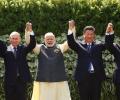
Narendra Modi's success at the BRICS summit is the best Diwali gift for India's diplomacy and marks her ascendancy to global leadership, says Tarun Vijay.

Secularism as a principle and practice in India is in "danger", but "forces of hatred" cannot alter the country's secular character, senior Congress leader Shashi Tharoor said during an interview on his new book 'The Battle of Belonging'. In the book, Tharoor makes a stinging critique of the Hindutva doctrine, asserting that it is a political doctrine, not a religious one.
'...but from those who control the narrative.' Powerful nations have mastered this art of narrative building. Those nations who aspire to become global powers must do so, observes Shanthie Mariet D'Souza.
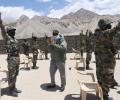
Only he, with his tremendous political capital and personal stature, can pull it off, observes B S Raghavan, the veteran civil servant.

The Tablighi Jamaat avoided confrontation, stayed clear of conversion of non-Muslims, abjured politics and focused only on religious attainment. >A fascinating excerpt from Ziya Us Salam's Inside The Tablighi Jamaat.

'It doesn't look as if any sensible, worldly wise, person is in charge in China.' 'If at all anybody is in charge, it can only be a bunch of bumpkins of whom Xi has become a puppet,' observes B S Raghavan, the veteran civil servant.

'He is seeking to harness the power of Indian Diasporas to national (support for India in global capitals) and political (enhance the Bharatiya Janata Party's support base) ends.'

Mission Shakti 'shows the development within India's military space programme, its desire to be seen as a global space power and its recognition of the potential dangers of China's counterspace programme.'

The Tamil Nadu chief minister may have opened a Pandora's Box on the religion front with the appointment of qualified non-Brahmin temple priests, observes N Sathiya Moorthy.

If purists are surprised as to why and how people are not demanding prohibition or not talking about past promises, both in the election manifestos five years back and even those made to the courts, the answer lies in how the state has been evolving and changing these past few years, says N Sathiya Moorthy.

As India strives to make its Act East Policy a comprehensive politico-diplomatic and economic success, Brunei gains more salience, says Dr Rahul Mishra.
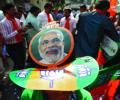
Retired senior US diplomats Teresita and Howard Schaffer believe the 'US cannot afford to continue restricting its contacts with Narendra Modi.' Rediff.com's Aziz Haniffa reports from Washington, DC.

The shift was sudden, quite unlike Shukla's departure from North Block, which had been anticipated for some months even before Singh''s first Budget.

'.. if the cost is its own survival,' says Colonel Anil A Athale (retd).

The contemporary problem with the BJP in Tamil Nadu is that it has been trying hard to package the DMK especially as anti-god and anti-Hinduism, and seeking it to link to Periyar and M Karunanidhi, and by extension to Stalin, the latter's son and successor to the party mantle. Their hope was to consolidate the perceived 'pro-god, pro-religion votes', which they saw returning to the fold post-MGR, post-Jayalalithaa. But no such substantial vote-bank existed even in Periyar's time, says N Sathiya Moorthy.

'We aren't so unreasonable as to demand that he should have fully reversed Indira Gandhi's worst economic legacy, bank nationalisation.' 'But he could have made a beginning by selling off the two most stressed small public sector banks, and then announced that each year for the next 10, one government bank with the most messed-up balance sheet will be sold.' 'It would have electrified the markets, shocked his other banks into better behaviour, and marked his name among the great reformers,' argues Shekhar Gupta.

Medha is an organisation created with the idea of bringing in better employment opportunities and life for educated youth.

The US wants to split Sino-India ties, says the Chinese media.
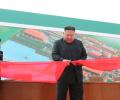
'What if Kim is alive as the latest reappearance suggests, but unable to rule?' 'Will his sister be installed as the leader to continue with the Kims's hereditary dynasty that began with the present ruler's grandfather?' asks Dr Rajaram Panda.

President Pranab Mukherjee on Thursday addressed the nation on the eve of the 68th Independence Day.

India should enhance its economic, cultural and defence ties with Mongolia. It is high time Modi should focus on gaining clout in smaller Asian countries such as Mongolia. It is in this context, India's engagement with Mongolia would give much-needed impetus to India's foreign policy, says Sana Hashmi.

Prime Minister Narendra Modi's visit to South Korea is considered essential in strengthening defence ties, enhancing economic cooperation and forging cultural ties between the two countries, says Dr Rahul Mishra

'Amit Shah and his fellow travellers need to realise that India was divided because of competitive communalism of forces like Hindu Mahasabha and the Muslim League, prodded, aided and abetted by the colonial power,' says Mohammad Sajjad.

'If the BJP thinks it is going to overnight transform Bengal into Madhya Pradesh, sorry, that's not going to happen because I have faith in our ethos and culture.'
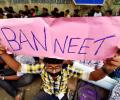
Once the Covid crisis subsides in the state, the NEET exam this year, whether conducted or cancelled, could become an electoral issue next year, along with the BC-MBC reservations issue, especially the 'creamy layer' aspect, says N Sathiya Moorthy.

'The US wants Modi to succeed because we want India to succeed. For our part, when India thinks of its partners in the world, we want it to think of the US first. That means positioning our country as the preferred provider of the key inputs that can help to propel India's rise.' 'The meeting between Modi and Obama is, and must be, an opportunity for true strategic dialogue -- not a scripted exchange of talking points, but an open discussion of the big questions. What kind of world do we want to live in? What are our true priorities? And most importantly, why does this partnership still matter?'

In an online chat with readers overseas consultant NNS Chandra offered advice.

'India will soon have the world's largest and youngest population -- just imagine what tomorrow's citizens of India will be able to accomplish, given the right education, training, and opportunity.'
'Modi remains the most popular politician in India; the BJP's organisational and fundraising prowess is considerable; and the Opposition, while newly collaborative, has no leader or clear economic messaging as of yet.'

'India should be able to weather the storm, given its enhanced standing among the major powers. However, India's international clout is partly from its rapidly growing emerging economy and a large and expanding commercial market. 'If the Indian economy continues to slow and protectionist barriers advance, then our international clout will also diminish. The international fallout from bringing the Valley to heel may be more difficult to handle,' says Shyam Saran.
